The LA DULA guide
Cebo, Cebo de Campo, Bellota, Pata Negra: four ways to love jamón ibérico
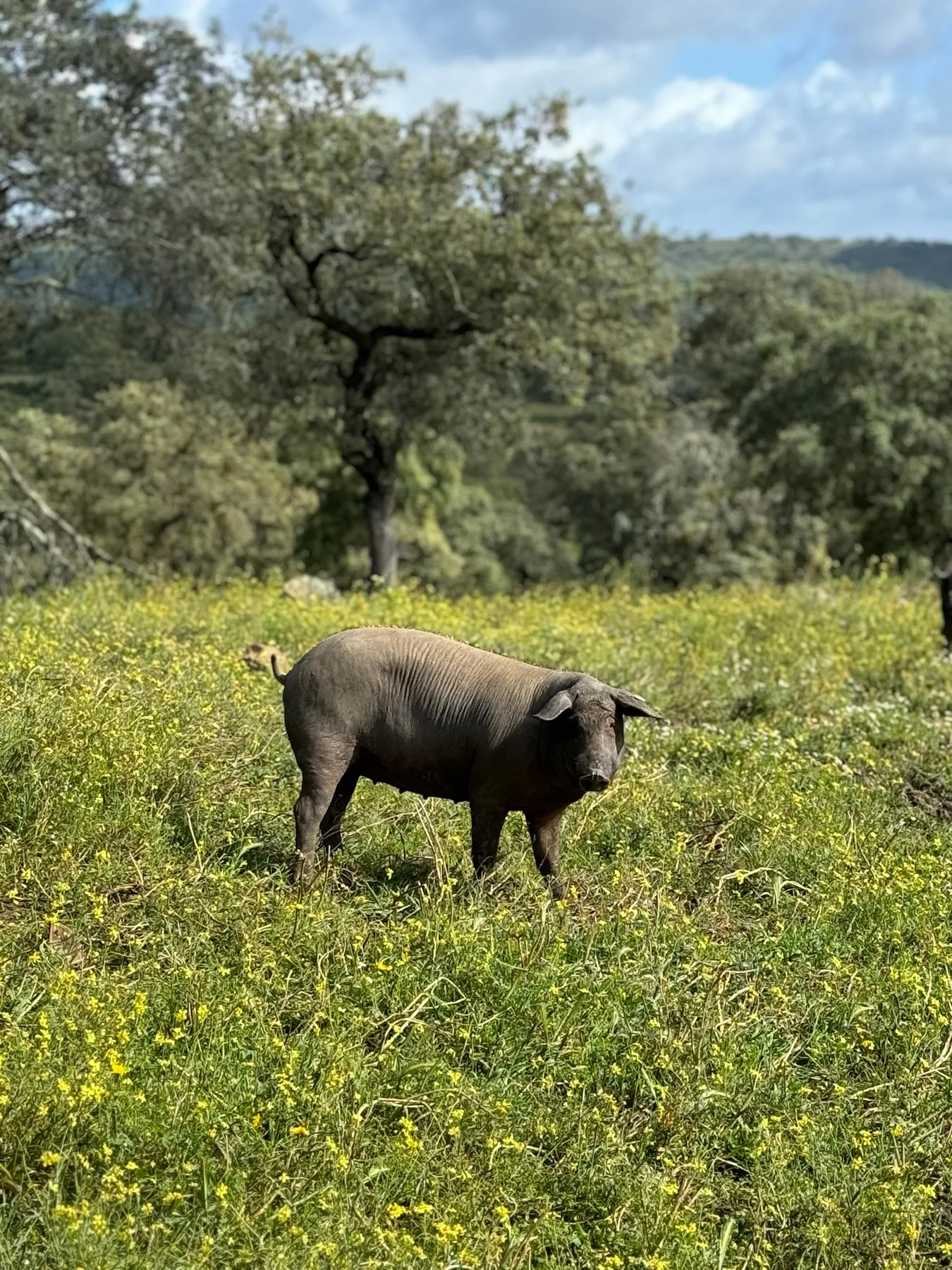
Pata Negra is the original ham, the one from the dehesas and the festive table. The three other grades were born of modern farming, and that is good news: they opened jamón ibérico up to every budget and every occasion. All that remains is to find the one made for you.
It is not a scale from worst to best
The four grades are often presented as a ranking, from the humblest to the most prestigious. Convenient, but wrong. Pata Negra is the traditional product, the original: a 100 % Iberian breed pig, free in the dehesa, fattened on acorns. The three other label colours are adaptations to modern farming. They democratised jamón ibérico and made it what it should always be: a moment of sharing, whatever the budget and whatever the occasion.
The four grades, side by side
One classification, four label colours. Breed, diet, curing time, and the price of one sliced envelope. We cut every envelope to order in our Geneva shop.
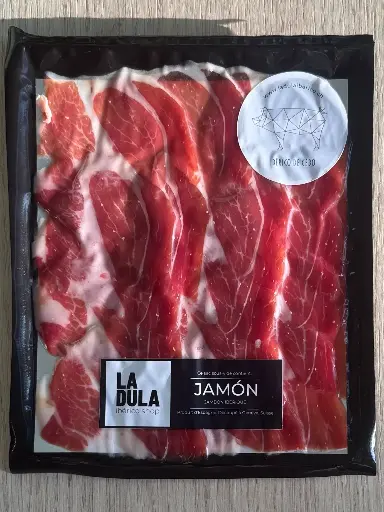
White label
Ibérico de Cebo
50 % Iberian breed, cereals and legumes, farm-raised. 26 months. This is where you discover how much the breed changes the taste.
CHF 15.90
The 100 g envelope, sliced in Geneva
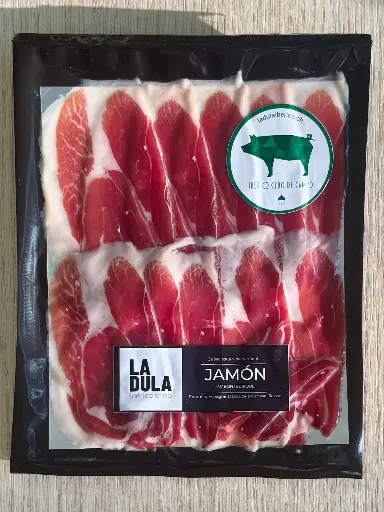
Green label
Ibérico de Cebo de Campo
50 % Iberian breed, outdoors in the dehesa, pasture and cereals. 30 months. More depth, still a ham for every day.
CHF 19.90
The 100 g envelope, sliced in Geneva
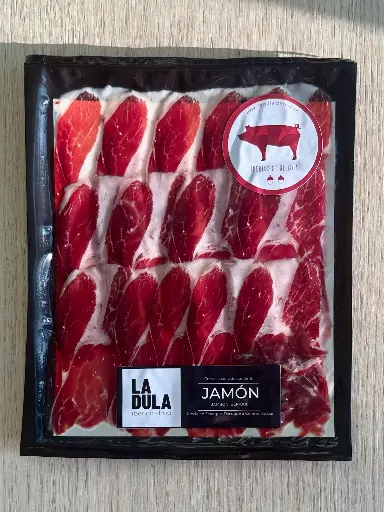
Red label
Ibérico de Bellota
50 % Iberian breed, free-range, fattened on acorns during the montanera. 36 months. Melting fat, hazelnut notes.
CHF 28.90
The 100 g envelope, sliced in Geneva
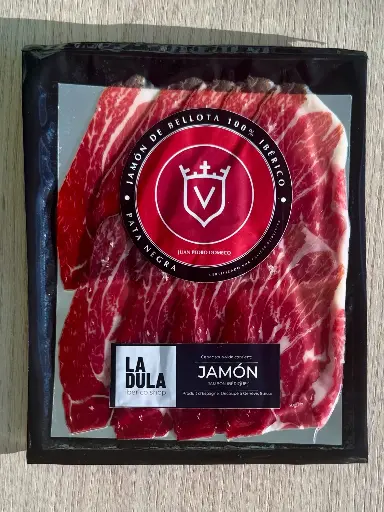
Black label
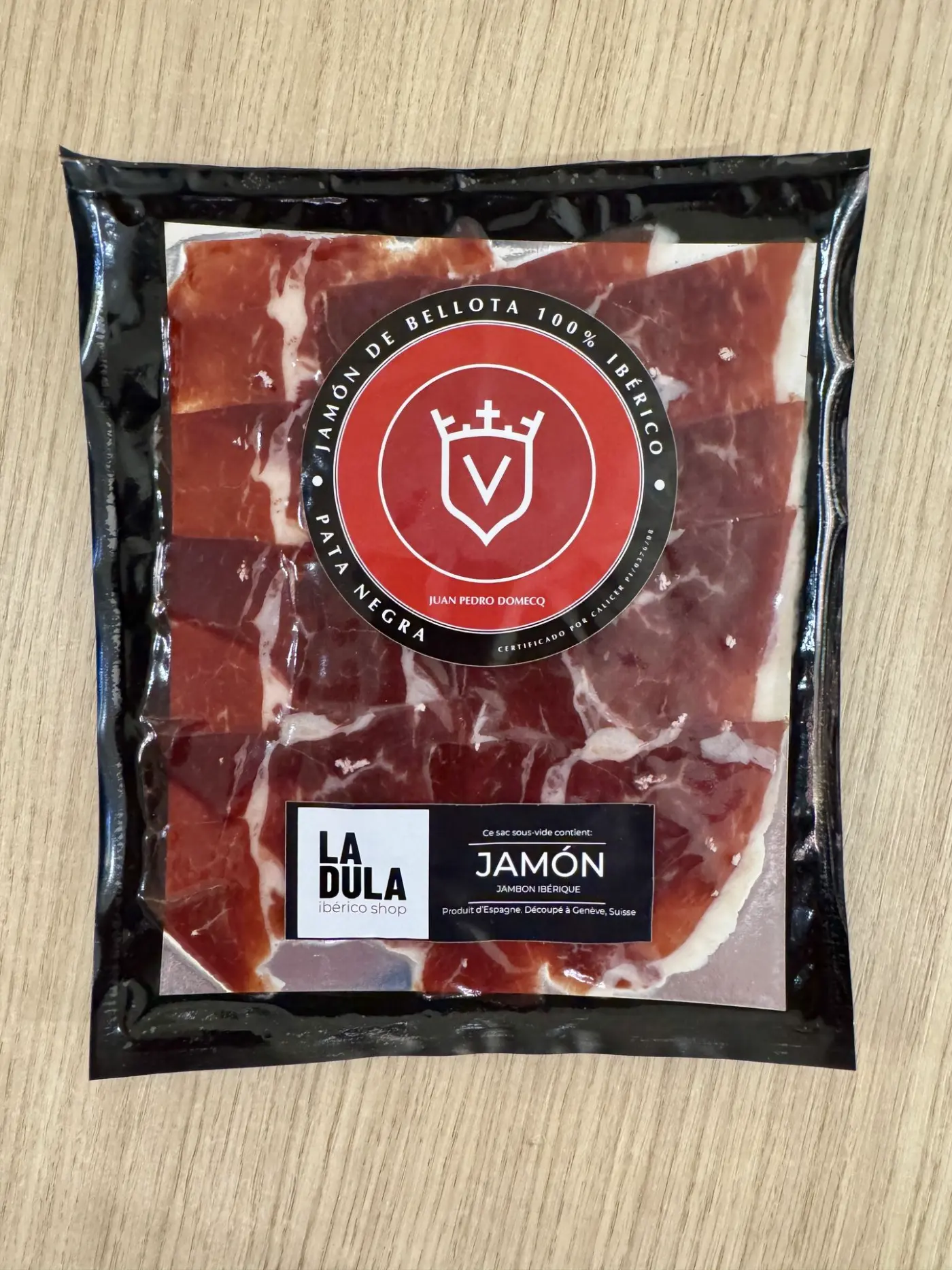
100 % Ibérico de Bellota — Pata Negra
Pure Iberian breed, full freedom in the dehesa, acorns only. 42 months. A power felt in the throat and a finish that stands alone.
CHF 39.90
The 80 g envelope, sliced in Geneva
Two things make the flavour, in this order
The breed of the pig first, its diet second. Understanding that order is enough to choose.
First, the breed
An Iberian pig is not a white pig. Its ability to marble fat through the muscle is what gives jamón its melting texture and its long finish. That is why Ibérico de Cebo — white label, 26 months of curing — is no consolation prize. It is precisely where you discover how much the breed changes the taste, and it is often the best way into the range.
Then, the diet
For a given breed, what the pig eats changes everything. Cebo is fed on cereals and legumes, raised on the farm. Cebo de Campo lives outdoors in the dehesa and feeds on what it finds there, supplemented with cereals. Bellota is free-range and fattened exclusively on acorns during the montanera. From one label to the next, the difference really is tasted: the fat becomes more melting, the aromas deeper, the finish longer.

Black label
Pata Negra stands apart
The 100 % Ibérico de Bellota — black label, 42 months — is not a better Bellota. It is something else. The breed is pure, uncrossed, and you feel it immediately: a power that catches at the back of the throat, like a great olive oil, and a length in the mouth that sets it apart from every other ham. This is the jamón of great occasions, and it is the one that built the reputation of the product.
A question of palate, not of budget
We like to compare jamón ibérico to wine. Nobody would call a 20-franc bottle a bad wine because 200-franc bottles exist. They are different moments, different palates, different tables. A Cebo shared on a Tuesday evening with friends is worth every bit as much as an exceptional piece opened for no occasion.
Bring the price back to the plate
From CHF 15.90 to CHF 39.90 the envelope, the gap is a few francs. Two people share one over an aperitif. The finest ham in the world costs less than a round of drinks.
The four grades at a glance
| Grade | Breed | Diet and rearing | Curing | Sliced envelope |
|---|---|---|---|---|
| Ibérico de Cebo | 50 % Iberian | Cereals and legumes, farm-raised | 26 months | CHF 15.90 / 100 g |
| Ibérico de Cebo de Campo | 50 % Iberian | Outdoors in the dehesa, pasture and cereals | 30 months | CHF 19.90 / 100 g |
| Ibérico de Bellota | 50 % Iberian | Free-range in the dehesa, acorns (montanera) | 36 months | CHF 28.90 / 100 g |
| 100 % Ibérico de Bellota (Pata Negra) | 100 % Iberian | Fully free-range in the dehesa, acorns (montanera) | 42 months | CHF 39.90 / 80 g |
Prices for the vacuum-packed sliced envelope, cut to order in our Geneva shop. The same logic applies to paletas, with shorter curing times.
Taste before you choose
The best advice we can give comes down to one word: come and taste. At the shop, rue Michelle Nicod 6 in Geneva, we slice in front of you and let you compare two grades side by side. In a few minutes, your palate decides better than any table.